
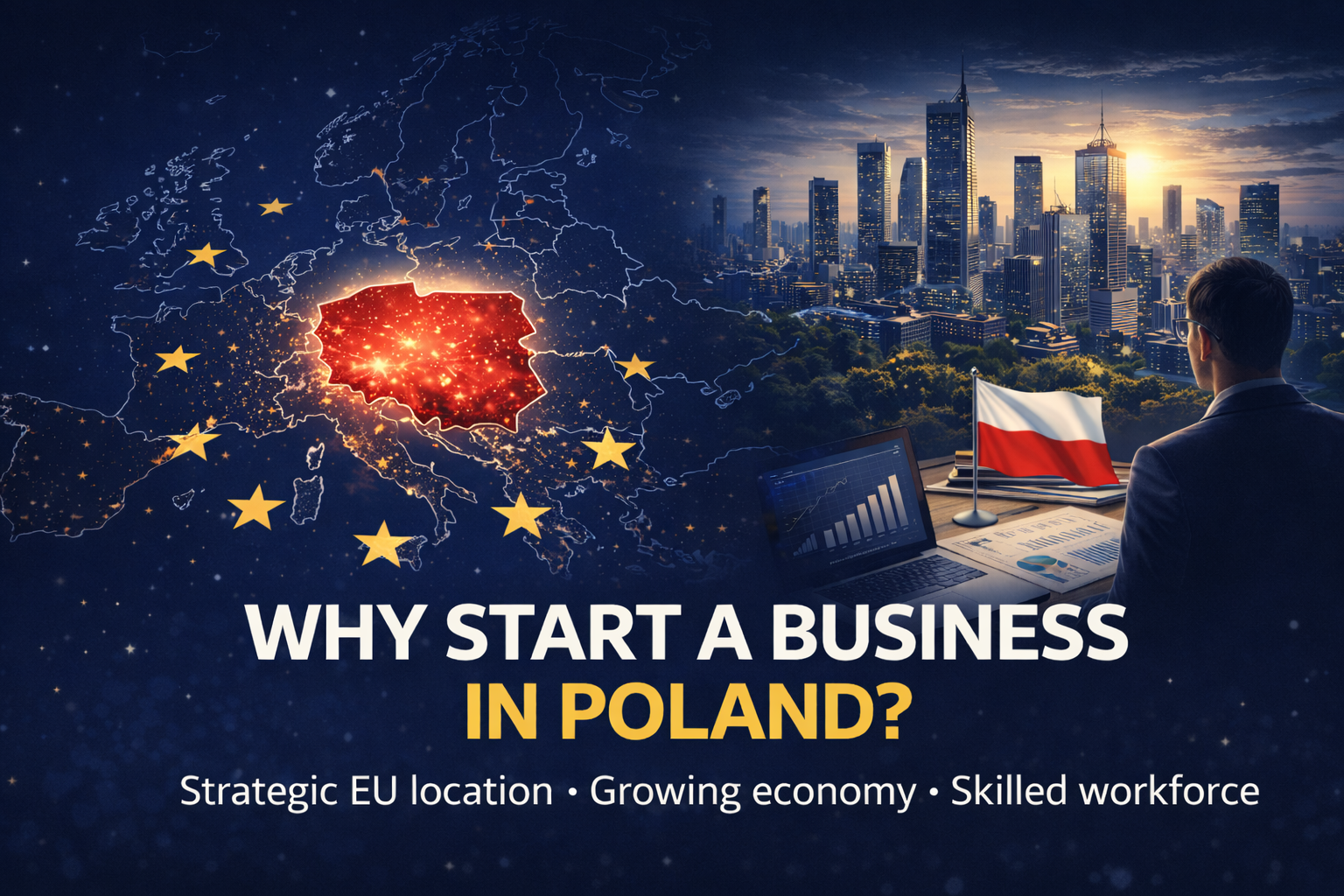
Updated for 2026. Poland has officially joined the world’s top 20 economies — overtaking Switzerland with a nominal GDP exceeding $1 trillion. For international entrepreneurs looking for an EU base, Poland has never been a stronger choice. Here’s why.
Poland Is a Fast-Growing Economy
While much of Europe struggles with stagnation, Poland keeps growing. With a 3.2% GDP growth rate in 2025 and a forecast of 3.1% for 2026, Poland is among the fastest-growing economies in the European Union. It’s the only EU country that avoided recession during the 2008 financial crisis — and it hasn’t stopped since. Thirty-five years of uninterrupted transformation have taken Poland from the 38th to the 20th largest economy in the world.
Poland by the Numbers: 2025/2026
| Indicator | Value |
|---|---|
| Global GDP ranking | 20th worldwide (nominal), 6th in EU |
| Nominal GDP | $1.04 trillion (2025, IMF) |
| GDP growth rate | 3.2% (2025), forecast 3.1% (2026) |
| GDP per capita (PPP) | $55,190 — now higher than Japan ($54,678) |
| Population | 38 million |
| EU membership | Since 2004 — full single market access |
| Corporate tax (CIT) | 9% (revenue under €2M) / 19% standard |
| Currency | Polish złoty (PLN) — competitive exchange rate |
| Amazon fulfillment centers | 11 — largest FBA hub in Central Europe |
| Credit rating | A- (S&P), A2 (Moody’s) |
The $1 Trillion Milestone
In 2025, Poland crossed the symbolic trillion-dollar threshold, overtaking Switzerland in the global GDP rankings. According to IMF projections, Poland’s economy is expected to continue growing at over 3% annually through 2026 — among the strongest rates in the EU.
This isn’t a sudden spike. Poland has been the only EU economy that avoided recession during the 2008 financial crisis. Between 1994 and 2024, average annual growth exceeded 4%, earning Poland the “European Tiger” label. The country’s GDP has increased sevenfold since 1990 — a transformation from the 38th to the 20th largest economy in the world in just 35 years.
Perhaps the most striking statistic: Poland’s GDP per capita at purchasing power parity has now surpassed Japan’s — $55,190 versus $54,678. While the two economies differ vastly in scale, this convergence illustrates the speed and depth of Poland’s economic development. For a country that emerged from a planned economy only 35 years ago, this is an unprecedented achievement in European economic history.
For international entrepreneurs, this translates into a stable, growing market backed by EU institutions, with none of the volatility associated with smaller or newer economies. Poland is not a micro-state offering paper companies — it’s a major European economy offering real operations in a real market.
Foreign Direct Investment: Global Companies Are Already Here
Poland consistently ranks among the top FDI destinations in Central and Eastern Europe. Major international companies have established significant operations:
- Technology: Google, Microsoft, Intel, Samsung, and LG all have engineering or service centers in Poland.
- Finance: Goldman Sachs, JP Morgan, Credit Suisse, and UBS operate major shared service centers in Warsaw and Kraków.
- Manufacturing: Volkswagen, Toyota, Mercedes-Benz, and dozens of automotive suppliers have production facilities.
- E-commerce: Amazon (11 fulfillment centers), Zalando, Allegro (Poland’s largest marketplace), InPost (smart lockers).
This corporate presence creates an ecosystem: established supply chains, experienced workforce, professional services, and infrastructure that smaller entrepreneurs can leverage. When Google and Amazon build operations in a country, the banking, logistics, and regulatory environment is already tested at scale.
Strategic Location: Europe’s Logistics Hub
Poland sits at the crossroads of Western and Eastern Europe. This geography is not just symbolic — it’s commercially decisive:
- Borders 7 countries — Germany, Czech Republic, Slovakia, Ukraine, Belarus, Lithuania, and Russia (Kaliningrad). Direct access to both EU and Eastern European markets.
- 450 million EU consumers — full single market access through one Polish entity.
- 24-hour delivery to the most populated parts of Europe; 48 hours to all of Europe.
- Major ports — Gdańsk, Gdynia, Szczecin for maritime trade.
- 5,200+ km of motorways and expressways — continuously expanding infrastructure.
- 11 Amazon fulfillment centers — one of the largest FBA hubs in Europe, making Poland the operational choice for EU e-commerce.
If your business involves moving physical goods anywhere in the EU, Poland’s infrastructure and location give you a head start. See our import-export company setup guide for details.
Tax Advantages: 9% Corporate Tax
Poland offers one of the most competitive tax environments in the EU for small and medium businesses:
- 9% CIT — for companies with annual revenue under €2 million. This covers the vast majority of newly formed companies.
- 19% standard CIT — for larger companies. Still competitive compared to Germany (30%), France (25%), or the Netherlands (25.8%).
- Estonian CIT model available — qualifying Polish companies can defer taxation until profit distribution, paying 0% on retained earnings. Effective rate on distribution: 20–25%.
- No minimum tax on dormant or low-activity companies.
- EU Parent-Subsidiary Directive — tax-efficient profit repatriation within EU corporate groups.
For a detailed comparison with other EU jurisdictions, read our Poland vs Estonia comparison.
EU Single Market: One Registration, 27 Countries
As an EU member state since 2004, Poland provides full access to the European single market — the world’s largest single market by GDP. A company registered in Poland can:
- Sell goods and services across all 27 EU member states without additional registration.
- Hire employees anywhere in the EU.
- Open bank accounts in any EU country.
- Access EU trade agreements with 70+ countries worldwide.
- Register for VAT OSS (One Stop Shop) — sell to consumers across all EU countries with a single VAT return.
Additionally, through the EEA agreement, your Polish company can operate in Iceland, Liechtenstein, and Norway. Switzerland has bilateral agreements providing similar access.
E-Commerce: Amazon’s Central European Hub
Poland has become Amazon’s biggest operational base in Central Europe. With 11 fulfillment centers, it offers:
- Direct access to Amazon.pl marketplace (launched 2021).
- Pan-European FBA distribution — inventory stored in Poland serves customers across Germany, France, Italy, Spain, and other EU markets.
- Straightforward EORI registration for importing goods into the EU.
- VAT EU (VIES) registration included in our formation packages.
For Amazon sellers, a Polish entity creates a clean operational and VAT chain — your company, your warehouse, and your marketplace presence all in one jurisdiction. Read our Amazon and e-commerce company guide.
Skilled Workforce and Digital Infrastructure
Poland produces 400,000+ university graduates annually — one of the highest rates in the EU. The country has become a major hub for IT and business services:
- Over 300,000 IT professionals — one of the largest developer pools in Europe.
- Business Process Outsourcing (BPO) hub — major service centers for Google, Microsoft, Goldman Sachs, and JP Morgan operate in Warsaw, Kraków, and Wrocław.
- Multilingual workforce — widespread English proficiency, plus German, Russian, French, and Spanish.
- Competitive labor costs — significantly lower than Western Europe while maintaining comparable quality.
For SaaS and digital businesses, Poland offers both the talent pool and the regulatory framework for EU operations. See our SaaS and digital company setup guide.
Banking and Financial Infrastructure
Unlike some smaller EU countries where international companies struggle with banking, Poland has a mature, internationally connected banking sector:
- Major banks — mBank, PKO BP, Santander, ING, BNP Paribas, Citi Handlowy.
- Traditional business accounts — credit lines, overdrafts, trade finance, multi-currency accounts.
- Integrated with EU payment systems — SEPA, SWIFT, real-time transfers.
- KSeF (national e-invoicing) — Poland is implementing mandatory e-invoicing in 2026, placing it at the forefront of EU digital tax compliance.
Opening a bank account for a Polish sp. z o.o. is a standard procedure — not the months-long obstacle course that founders experience in Estonia or other smaller jurisdictions.
Regulatory Environment: Predictable and EU-Aligned
Poland’s legal framework is fully aligned with EU regulations:
- GDPR — implemented and enforced. Polish entity provides full GDPR compliance for EU data processing.
- MiCA — EU crypto-asset regulation being implemented. Poland requires VASP registration for crypto activities.
- EU Anti-Money Laundering Directives — full compliance with AML 5 and AML 6.
- EU Company Law Directive — standardized corporate governance, cross-border mergers, and conversions.
- Central Register of Beneficial Owners (UBO) — mandatory filing, ensuring transparency.
For fintech and crypto businesses, see our regulatory advisory page.
Company Formation: Fast and 100% Remote
Forming a Polish company (sp. z o.o.) is straightforward for international founders:
- No visit to Poland required — entire process handled remotely via power of attorney.
- Any nationality welcome — 100% foreign ownership permitted.
- Ready-made company — operational in 2–5 days.
- Minimum share capital — PLN 5,000 (~€1,150).
- Fixed pricing from €2,200 — no hidden fees, no hourly billing.
Our formation packages include registered address, VAT EU registration, EORI number, UBO filing, and full English-language documentation. See full package details.
Why Not Poland? Common Concerns Addressed
“Poland uses Polish for official filings”
True — official documents are in Polish. That’s why you work with a licensed Polish attorney who handles all filings and provides everything in English. You never need to deal with Polish-language bureaucracy directly.
“Poland isn’t in the Eurozone”
Correct — Poland uses the złoty (PLN). For international trade, this is actually an advantage: the competitive exchange rate keeps operational costs lower. All major banks offer multi-currency accounts (EUR, USD, GBP), and SEPA transfers work normally.
“I’ve heard compliance is complex”
EU compliance is complex everywhere — that’s why we offer integrated accounting and compliance services alongside company formation. Monthly bookkeeping, VAT returns, annual filings, and KSeF e-invoicing — all handled by one team. See our compliance and accounting services.
Poland in 2026: The Bottom Line
Poland has transformed from a post-communist economy to the world’s 20th largest in just 35 years — the fastest economic ascent in modern European history. With a GDP per capita now exceeding Japan’s on a purchasing power basis, stable 3%+ growth, and full EU integration, it offers international entrepreneurs something rare: substance, scale, and stability in one package.
Whether you’re building an e-commerce operation, a SaaS platform, a trading company, or a fintech venture — Poland provides the infrastructure, the tax advantages, and the regulatory framework to do it right.
Frequently Asked Questions
Can I register a company in Poland without visiting the country?
Yes. The entire formation process — from signing the power of attorney to receiving your KRS registration — is handled 100% remotely by licensed attorneys. You don’t need to visit Poland at any stage. We serve clients from 30+ countries who have never set foot in Poland. All documentation is provided in English, and communication is handled entirely in English.
What type of company should I form?
The standard choice for international entrepreneurs is a sp. z o.o. (spółka z ograniczoną odpowiedzialnością) — equivalent to a limited liability company (LLC/Ltd). It provides limited liability, flexible ownership structure, and access to the 9% CIT rate. Minimum share capital is PLN 5,000 (~€1,150). For most business models — e-commerce, SaaS, trade, consulting — this is the optimal structure.
How long does it take to have a fully operational company?
With our ready-made company model: 2–5 business days from signing the power of attorney. This includes KRS registration, director appointment, and registered address activation. VAT EU (VIES) and EORI registration follow within 5–10 additional days. With the Premium package, accounting onboarding begins immediately.
What ongoing obligations does a Polish company have?
Monthly bookkeeping and VAT returns (if VAT-registered), annual financial statements filed with KRS, UBO registry updates, and — from 2026 — mandatory e-invoicing through KSeF. All of these are handled by our accounting team as part of our compliance packages. Typical monthly cost: €150–400 depending on transaction volume.
Is Poland better than Estonia or other EU countries?
It depends on your business model. For e-commerce, import/export, and businesses that need substance, banking, and logistics — Poland is typically the stronger choice. For solo digital nomads with no physical products and no need for traditional banking, Estonia may work. We’ve written a detailed Poland vs Estonia comparison to help you decide.
Can any nationality form a company in Poland?
Yes. There are no nationality restrictions on company ownership in Poland. Citizens of any country can own 100% of a Polish sp. z o.o. We have formed companies for founders from Turkey, China, India, USA, UK, UAE, Israel, South Korea, Nigeria, and many other countries. Sanctioned individuals or entities are the only exception.
What are the real costs of running a Polish company?
Formation from €2,200 (one-time). Registered address: ~€300–500/year. Accounting and compliance: €150–400/month. Qualified electronic signature: €350 (valid 3 years). Bank account: free or minimal fees. No hidden costs — we provide a complete cost breakdown before you commit.
Ready to Start?
Book a free qualification call with our team. We’ll assess your business model and tell you exactly what you need to get started — with fixed pricing and no surprises.
From €2,200 — compliant EU company operational in days.